Muddy Water Filter Lab
A little muddy water, a few layers and a drip-drop discovery!
Imagine you’re a tiny squirrel exploring after a rainy night.
Drip, drop, drip! Water is trickling past little stones and fallen leaves.
You notice something floating in the water. Where might it go if the water passed through a filter?
Today, you’re going to become a woodland water scientist! With your grown-up adventure buddy, you’ll build a little filter and see what it catches.
Will the water look different on the other side? Let’s investigate!
Little water rule: This experiment is for watching, never drinking—even if the water looks clear.
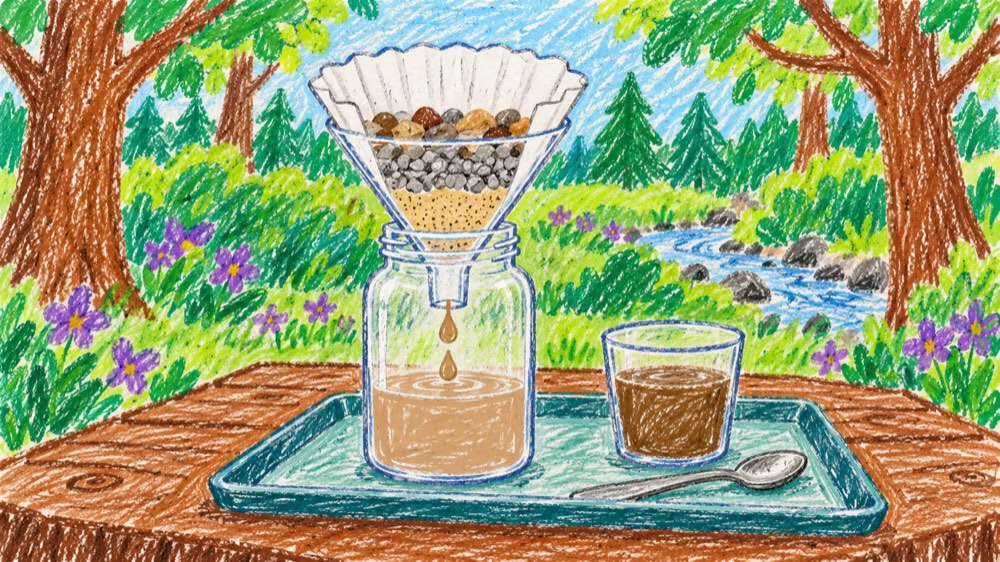
What you’ll need
- A reusable funnel
- A paper coffee filter large enough to line the funnel
- Clean play sand
- Clean aquarium gravel and a few clean pebbles
- Two clear containers: one for mixing and one to collect the drips
- Tap water and a small spoonful of soil chosen by your grown-up
- A spoon
- A tray and a towel for spills
- A piece of white paper
- Your grown-up adventure buddy
Ask your grown-up to choose soil from a spot without animal mess or known chemical contamination. Don’t use potting compost or collect water from puddles, ponds or streams.
No cutting or sharp tools needed!
Your mission
-
Step 1: Set up your little lab
Find a flat, steady surface with your grown-up. Put your equipment on a tray and keep a towel nearby.
Place your empty collecting container on the tray. Ask your grown-up to check that the funnel rests securely in its opening, with room underneath for water to drip.
Keep your experiment separate from drinks and snacks.
Explorer question: Where do you think the water will go after it passes through the funnel?
-
Step 2: Make your muddy mixture
Pour some tap water into your mixing container.
Ask your grown-up to add a small spoonful of soil, then gently stir.
Look closely. Can you see little pieces floating or sinking?
Save some of this mixture so you can compare it with the water that comes through your filter.
Explorer question: What happens if you stop stirring and watch for a little while?
-
Step 3: Build your filter layers
Line the inside of your funnel with the paper coffee filter. Moisten it with a little tap water to help it sit against the sides.
Gently spoon in a shallow layer of sand. Add a layer of small gravel, then a few pebbles on top.
Leave plenty of space above your layers for pouring. Ask your grown-up to steady the funnel.
Explorer question: Which layer has the biggest pieces? Which has the smallest?
-
Step 4: Watch the drip-drop journey
Give your muddy mixture another gentle stir.
Slowly pour a small amount onto the top layer. Pause and let it trickle through before adding more. Keep the water below the edge of the filter paper.
Watch the container underneath.
Drip… drop… what can you see?
Little water reminder: Don’t taste the mixture or the water that comes through. Clear-looking water can still contain things that could make us sick.
Explorer question: Is the water coming through quickly or slowly?
-
Step 5: Compare your discoveries
Place your original mixture and the collected water beside each other.
Hold a piece of white paper behind them to help you see the difference.
Does one look cloudier? Can you see fewer floating pieces? Perhaps they look quite similar!
Every result gives you something to investigate.
Look at the top of your filter too. Can you see anything left behind?
Little science secret: A filter can catch some solid particles as water passes through. It won’t necessarily catch everything.
Explorer question: What changed, and what stayed the same?
-
Step 6: Try one little change
Would you like to investigate again?
With your grown-up, set up a fresh coffee filter and change just one thing. You could try a slightly thicker sand layer.
Keep the other layers similar. Stir your remaining muddy mixture and pour through the same amount as before.
Compare your results. Did your change affect how the water looked or how quickly it dripped?
If you only have one collecting container, draw your first result before your grown-up empties and rinses it.
Explorer question: What did you notice after changing one thing?
-
Step 7: Leave your lab lovely
Your little water investigation is complete!
Ask your grown-up to collect the used soil, sand, stones and filter paper for suitable disposal or cleaning. Keep these solids out of sinks and drains.
Let any remaining muddy water settle. Your grown-up can pour off the liquid into a household wastewater drain and put the leftover sediment in the bin.
Clean your equipment and surface, then wash your hands with soap and water.
Little explorer reminder: Your water doesn’t need to look clear for your experiment to count. Scientists learn by noticing what actually happens!
Adventure from indoors
Rainy day? Your little lab can come inside!
Set up on a tray at a table or kitchen worktop with your grown-up. Keep it away from food preparation and use the same homemade muddy mixture.
Want to try a simpler filter first?
Here’s what to do:
- Line your funnel with a fresh paper coffee filter.
- Place it securely over your collecting container.
- Stir your muddy mixture and slowly pour a small amount through.
- Look for particles left on the paper.
- Compare the collected water with your original mixture.
Explorer question: What could the paper catch? What seemed to pass through?
You can try the layered version afterwards and compare your observations.
Remember: all the experiment water is for watching, never drinking.
Your mindful moment
Drip… drop… drip…
Your little filter is taking its time.
You can take a tiny pause too.
Keep your experiment steady on the tray and settle somewhere comfortable beside it.
Let your shoulders soften.
Take a gentle breath in… and slowly breathe out.
There’s no need to match your breathing to the drops. Let your breath find its own comfortable pace.
Watch a drop gather.
Notice it fall.
Can you hear a little plip as it lands?
Maybe the drops come quickly. Maybe there’s a quiet wait between them.
You don’t need to hurry them along.
Take another gentle breath.
For a few little moments, you can simply sit, watch and wonder.
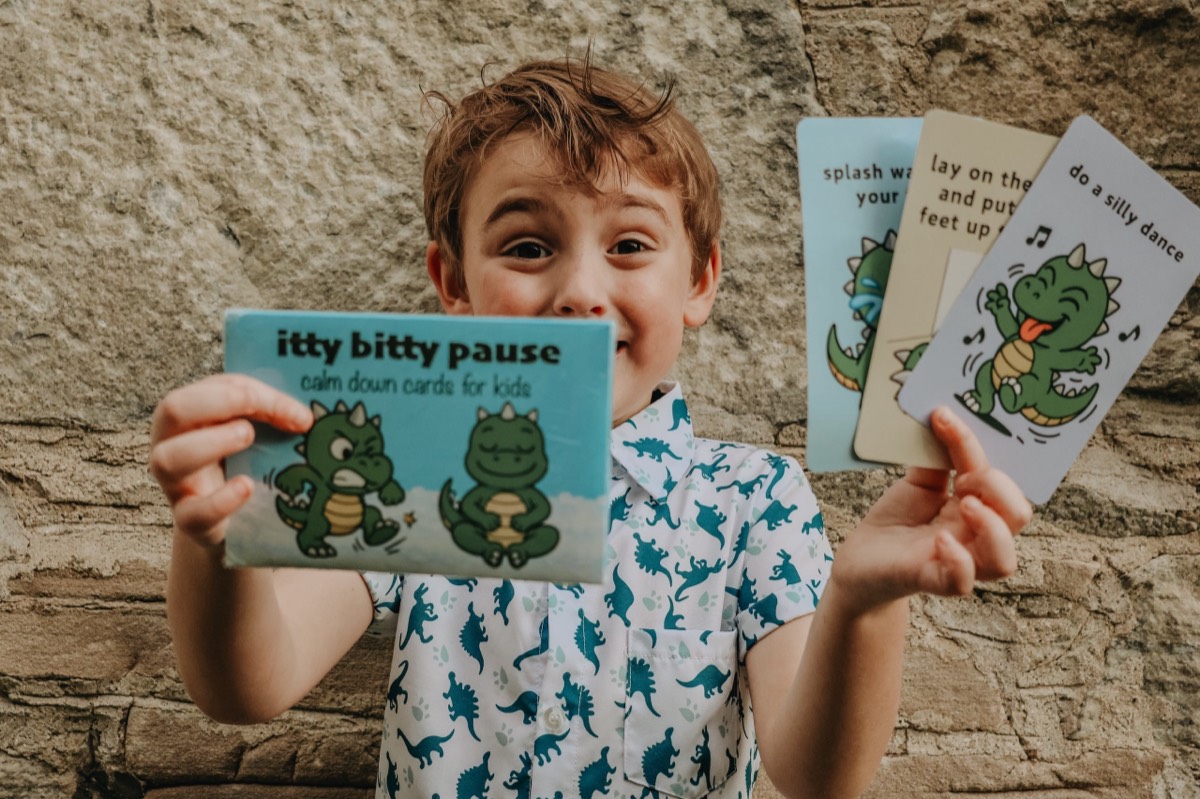
Take the calm home
Loved this mindful moment? Our itty bitty pause card decks hold 25 more little ways to breathe, move and reset, ready for bedtime, the car or the next big feeling.
Meet the calm cards