Secret Sit Spot
Psst… little explorer! Shall we borrow a trick from a woodland mouse?
Imagine a tiny mouse tucked beneath a big leaf. From there, it can hear the patter of rain and see the grass bend when something brushes past. What might we discover if we picked a spot and stayed awhile, too?
Today, you and your grown-up are going to find a Secret Sit Spot. You’ll give it a name, look for little clues and choose one thing to check on the next time you visit.
Ready? Let’s find your lookout!
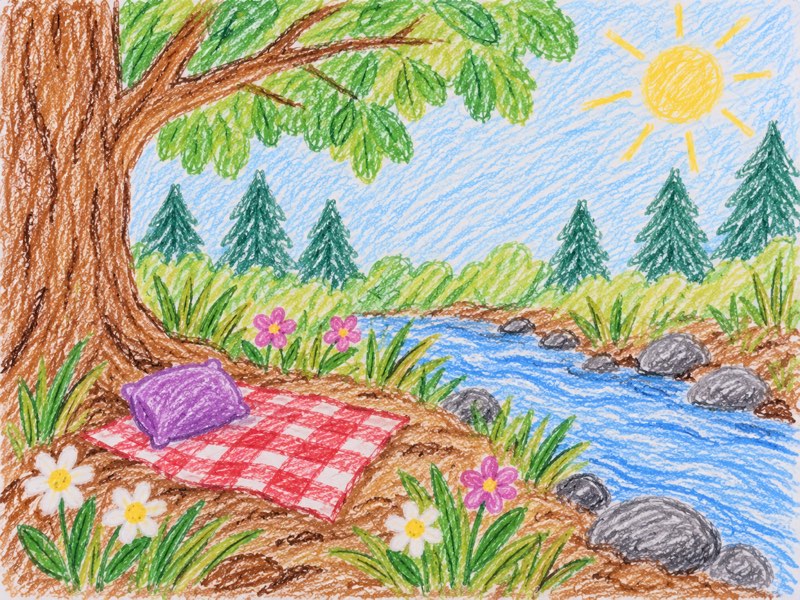
What you’ll need
- A safe, comfy spot in a familiar garden, park or woodland
- Your grown-up adventure buddy
- A small blanket or cushion, if you’d like one
- Paper and a pencil for drawing your discoveries, if you’d like
Little tip: A bench, a patch of grass or a place beside a tree can all make lovely lookouts. Choose somewhere you and your grown-up can settle together, away from water, roads and steep edges.
Your mission
-
Step 1: Give your lookout a secret name
Every good lookout needs a name! Find a spot with your grown-up and see what’s nearby. A tree with twisty roots might give you Tanglewood Corner. A bench with a good view of the garden might become Bumblebee Lookout.
Sit, stand or lean somewhere steady. The name can be your little secret, and your grown-up gets to be in on it, too.
Explorer question: What’s one thing about your spot that could go in its name?
-
Step 2: Listen for a sound nearby and a sound far away
Listen for something close. Can you hear the grass brushing against your shoe? The rustle of your sleeve? Now listen a little farther away. There might be a dog barking, a car going by or a bird calling from somewhere you can’t see.
You and your grown-up can each pick one sound. See if the other person can hear it, too.
Explorer question: Which sound would you have missed if you’d walked straight past?
-
Step 3: Look for a clue someone left behind
From your spot, look for something that makes you wonder what happened here. Perhaps there’s a leaf with a scalloped edge, a little mound of soil or a thread of spider silk catching the light. See what you can spot from where you are. Leave each clue right where you found it.
Little bushcraft secret: A clue can tell you something happened even when you weren’t there to see it. A hole in a leaf might be a sign that something had a snack. You can wonder who did it and keep looking for clues.
Explorer question: What’s your best guess about how your clue got there? Can your grown-up think of another possibility?
-
Step 4: Watch one little thing for a while
Pick something you can see from your lookout. Maybe it’s the tip of a branch, a puddle you can see from a safe distance or the edge of a shadow. Watch it for a few breaths. Does it wobble? Does the light change? Does it stay just the same?
If you’d rather listen, pick one sound and see if it comes back. You can wriggle, stretch or finish whenever you’re ready.
-
Step 5: Leave yourself a question for next time
Before you go, choose something you’d like to check when you come back. Will there be more leaves under the tree? Will the same bird be calling? Where will the shadow fall?
Tell your grown-up your question or draw a little reminder. Next time, settle into the same spot and see what you find. You might discover that your familiar little corner has a few more secrets.
Little explorer reminder: A few breaths at your spot is plenty to begin. Some days your biggest discovery might be that the leaf you watched stayed exactly where it was.
Adventure from indoors
No woodland nearby today? Let’s make a Window Lookout!
Here’s what to do
- Choose your lookout. Find a comfy seat beside a closed window with your grown-up. Give it a name.
- Pick one patch to watch. Try a branch, a fence post or a corner of the pavement.
- Find a little clue. Perhaps there’s a leaf caught against the fence or a rain trail on the glass. What do you think happened?
- Give it a few breaths. See what moves, what changes and what stays put.
- Come back later. Can you find the same clue from your lookout? What’s different now?
Can’t see much from your window?
Choose a spot anywhere indoors. Watch the light on a wall or listen for a sound that comes and goes. Can you tell when the fridge stops humming? Does the bright patch on the floor reach the chair later in the day?
Your mindful moment
You’ve found a lookout and gathered a few clues. Now let’s take an itty bitty pause with our little woodland mouse.
Find a comfortable way to settle with your grown-up. Feel whatever is holding you up. It might be the ground beneath your shoes, the chair beneath you or the soft blanket under your hands.
Imagine our little mouse tucked beneath a big green leaf.
A raindrop lands on the leaf.
Tap.
The leaf gives a little bounce. The mouse stays under its green umbrella and listens until the sound has faded.
See if you can hear one sound where you are. It can be loud or soft, near or far. Perhaps it’s your grown-up shifting beside you. Perhaps it’s the wind or the little sound your clothes make when you move.
Listen for as long as you like.
Now let a breath come in gently…
And let it go again, at its own easy pace.
Another raindrop lands near the mouse. This one falls right off the leaf and disappears into the grass.
See if there’s a second sound to notice. Maybe the first sound is still there. If it’s quiet, feel the spot where your hand is resting. Is it warm? Cool? Soft? A little bumpy?
The mouse pokes its whiskers out from under the leaf. There’s a tiny drop of water hanging from the tip. It waits a moment to see what will happen.
If you’d like, stay for one more breath. You can look around, wiggle your toes or lean a little closer to your grown-up.
When you’re ready, give your fingers a wiggle. What’s the first thing you notice as you get ready to move again?
Take a little pause home
A pause can happen beside a tree, by a window or in the middle of a busy day.
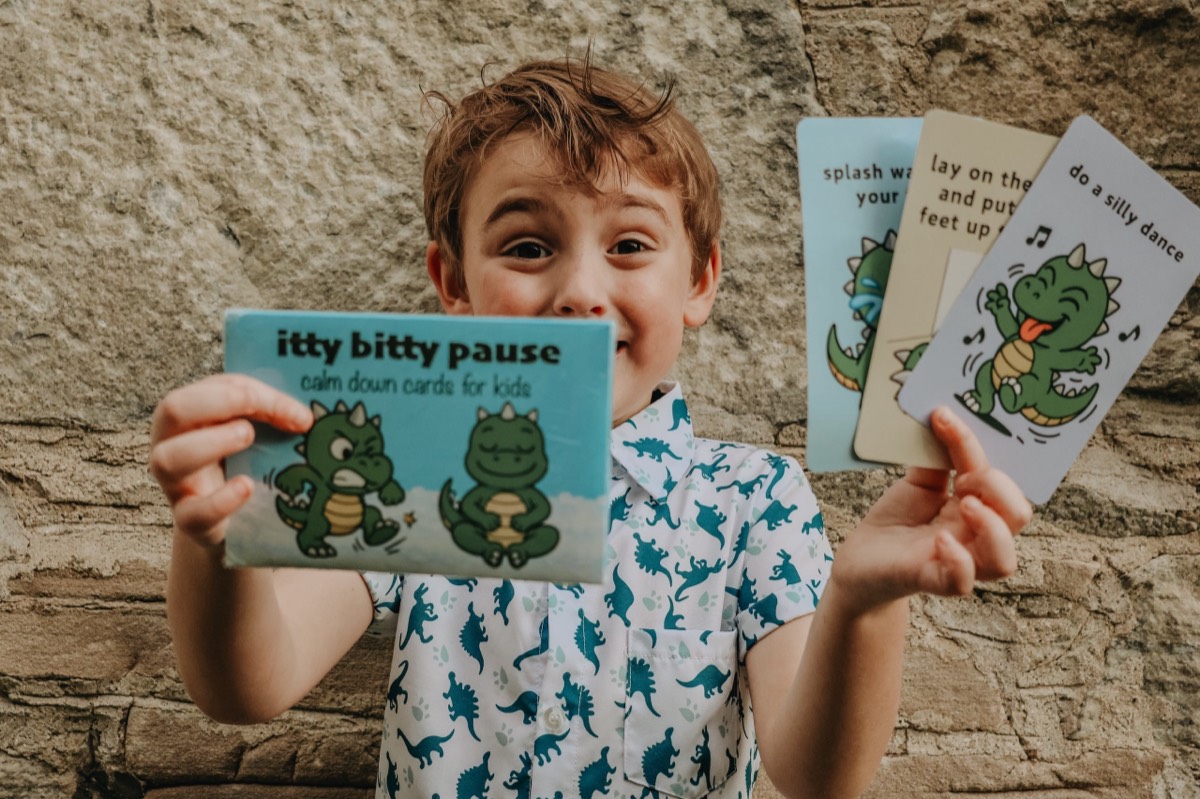
Our itty bitty pause card decks offer simple illustrated prompts for breathing, movement and imagination—more little things to try together.
Meet the calm cards